How Children Start Sailing: The Most Popular Sailing Sports for Kids

Updated: Sep 26
Many children do not start sailing on big boats.
They usually start in small dinghies, sailing schools, clubs, summer courses, or simple family sailing days. And honestly, this is often the best way. A small boat teaches a child very quickly what the wind is doing, what the water feels like, and why pulling the wrong rope can suddenly become everyone’s problem.
The most popular sailing sports for kids are not only about racing. They are also about confidence, balance, independence, teamwork, and learning how to stay calm when the wind has other plans.
In our family, sailing started with an Optimist. My son was 8 years old when he first began, and by 13 he had moved on to Laser. Looking back, I think those small boats taught him much more than just how to sail. They taught him independence, patience, and how to stay calm when the wind had other plans.
That is one of the beautiful things about sailing for children. They may start by learning how to steer a small boat, but slowly they also learn how to trust themselves.
How Children Usually Start Sailing
Most children start sailing in a very simple way: a short course, a local sailing club, a summer camp, or a family boat.
Some children begin because their parents sail. Some start because they live near the sea or a lake. Some try it once during a holiday and suddenly become the child who talks about wind direction at breakfast.
Usually, the first step is not about speed or racing. It is about feeling safe on the water.
Children learn how to sit in the boat, steer with the tiller, control the sail, understand basic wind direction, and come back to shore without too much drama.
The best beginner sailing programs keep things playful. Children need time to splash, make mistakes, laugh, capsize, climb back in, and discover that water is not the enemy. It is just very good at reminding you who is in charge.
Optimist: The Classic First Sailing Boat
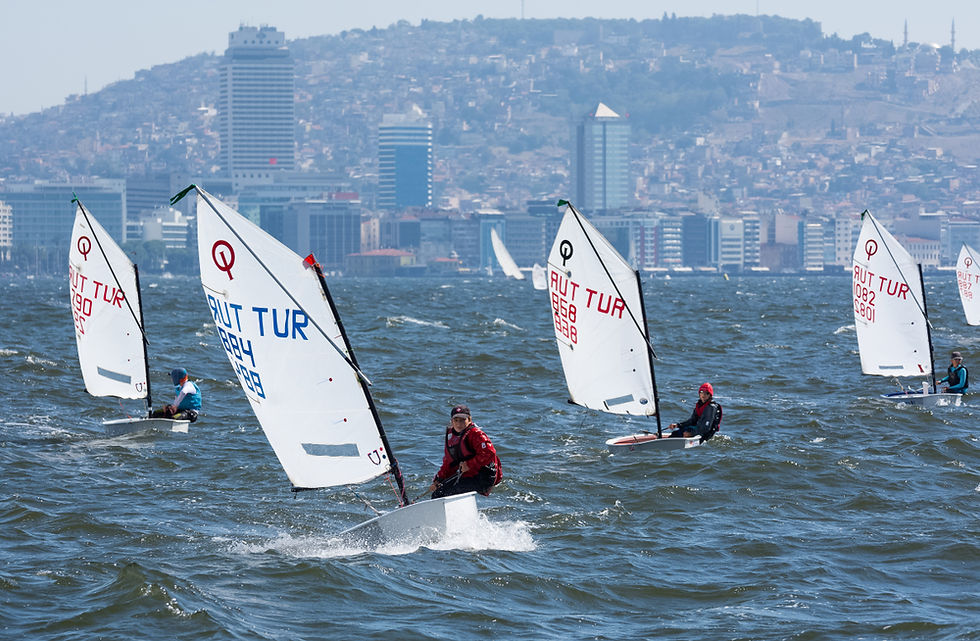
The Optimist is probably the most famous beginner sailing boat for children.
It is small, simple, and designed for young sailors. In many countries, it is the first boat children use when they start sailing. The Optimist is usually sailed alone, which means children learn independence very early.
At first, an Optimist can look almost too small to adults. But for children, that is part of its magic. It gives them their own little world on the water. They steer, trim the sail, make decisions, and slowly understand how the boat reacts.
The Optimist is also a very popular racing class. Many children use it just for fun, but others move into club racing, national events, and international competitions. Some of the world’s best sailors started in Optimists before moving into bigger dinghies and Olympic classes.
But a child does not need to become a serious racer to benefit from it. Even a simple Optimist course can teach them balance, responsibility, wind awareness, and confidence.
Best for: younger children, first sailing lessons, independence, basic boat handling, and early racing.
Laser / ILCA: A Step Up for Older Young Sailors
After Optimist, many young sailors move into a Laser, now officially known in racing as ILCA.
This is usually for older, stronger, or more experienced children and teenagers. The boat is faster, more physical, and less forgiving than an Optimist. It also gives a very direct feeling of sailing. If you make a mistake, the boat tells you immediately. Sometimes politely. Sometimes by throwing you into the water.
There are different rig sizes, which is one reason the Laser/ILCA pathway works well for youth sailors. Younger or lighter sailors may start with a smaller sail, then move up as they grow and gain experience.
For many children, this is the stage where sailing becomes more serious. They learn stronger boat handling, hiking, racing tactics, and better control in wind. It can be demanding, but it also builds a lot of confidence.
This was the step my son made after Optimist. When he moved to Laser around 13, sailing became more physical and more independent. It was still the same sea, the same wind, the same child — but suddenly the boat asked more from him.
Best for: teenagers, stronger youth sailors, racing development, and children moving on from Optimist.
Splash: A Fun Youth Dinghy Between Beginner and Performance Sailing
The Splash is another youth dinghy that can be a good step after beginner sailing.
It is a single-handed dinghy, usually sailed by older children or teenagers. It is smaller and more manageable than some high-performance boats, but still gives young sailors a faster, more active experience than a beginner dinghy.
For teenagers who are too big for Optimist but not ready for a very physical boat, Splash can be a nice middle step. It allows them to sail alone, gain confidence, and enjoy the feeling of speed without jumping too quickly into something too demanding.
Splash is not as universal as Optimist or Laser/ILCA in every country, so availability depends on local clubs and second-hand boat markets. But where it is used, it can be a fun and practical youth sailing option.
Best for: teenagers, sailors moving on from beginner boats, and young people who want single-handed sailing without too much pressure.
RS Feva and Double-Handed Dinghies
Not every child wants to sail alone.
Some children prefer sailing with a friend, sibling, or teammate. This is where double-handed dinghies like the RS Feva can be a great option.
In a two-person dinghy, children learn teamwork. One child may steer while the other handles the jib or spinnaker. They have to talk, listen, move together, and make decisions as a team. This is wonderful when it works and very educational when it does not.
Double-handed sailing can be especially good for children who are social, nervous about being alone, or simply enjoy sharing the experience. It also teaches communication in a very real way. On a small boat, “I thought you were going to pull that rope” becomes an important life lesson.
Some youth sailors later move into boats like the 420 or 29er, especially if they become interested in racing. These boats are more technical and physical, so they usually come after basic sailing skills are already strong.
Best for: children who like teamwork, siblings or friends sailing together, and young sailors moving toward youth racing.
Windsurfing for Kids
Windsurfing is another popular sailing sport for kids, especially in places with warm water, steady wind, and good schools.
It teaches balance, body awareness, and wind feeling in a very direct way. Children learn quickly that the sail, board, wind, and body all need to work together. When they do not, they fall in. Luckily, falling in is often part of the fun.
Windsurfing can be a good choice for active children who enjoy movement and do not mind getting wet. It may feel less “boat-like” than dinghy sailing, but it still teaches wind direction, sail control, and confidence on the water.
Modern beginner windsurf equipment is lighter and easier than older equipment, which makes it more child-friendly. A good instructor and suitable conditions are still very important.
Best for: active children, warm-water locations, balance, confidence, and playful wind learning.

Wing Foiling and Newer Water Sports
In recent years, more children and teenagers have become interested in wing foiling.
Wing foiling uses a handheld wing and a board, sometimes with a hydrofoil underneath. It looks exciting, modern, and slightly like something invented by people who thought normal balance was too easy.
For younger children, wing foiling may be too difficult at first. But for older kids and teenagers who already have good balance, confidence in the water, and some wind experience, it can be very attractive.
Many young sailors who already windsurf, surf, or sail dinghies may enjoy trying wing sports later. It is not usually the first step into sailing, but it can become part of a child’s wider water-sports life.
Best for: older children and teenagers, confident swimmers, sporty kids, and those who already understand wind basics.
Sailing on Family Cruising Boats
Not all children start in sailing schools or dinghies.
Some start on family cruising boats. They help with lines, steer for a few minutes, sit in the cockpit, watch the sails, and slowly understand how life on a boat works.
This kind of sailing is very different from dinghy sailing. It is not as direct, and the child may not control the whole boat alone. But it can still be a beautiful way to grow up around the sea.
Children on cruising boats often learn practical seamanship without even noticing. They learn how to move safely on deck, how to respect weather, how to use a life jacket, how to listen during manoeuvres, and how to understand that the boat is not a playground all the time.
For some children, this is enough. They do not need racing or formal classes. They simply become comfortable around boats and water. For others, family cruising becomes the doorway to dinghy sailing, racing, or other sea sports.
For a wider look at family boat life, you can also read our guide to sailing with kids, especially if your child is learning around a cruising boat rather than in a dinghy club.
Best for: children in sailing families, relaxed learning, seamanship, and building comfort around boats.
Racing or Just Fun?
This is an important question.
When children start sailing, adults often wonder if they should race. Racing can be wonderful. It teaches focus, tactics, discipline, resilience, and decision-making under pressure.
But racing is not the only way to enjoy sailing.
Some children love competition. They like starts, marks, results, and the feeling of improving. Others prefer exploring, playing, swimming, or simply sailing around without a coach shouting instructions from a RIB.
Both are valid.
A child does not have to become a racer to become a sailor. And sometimes, pushing too hard too early can take the joy away. The best sailing path is usually the one that keeps the child curious, safe, and happy to come back next time.
If your child becomes interested in the racing side later, our guide to amateur sailing races explains how relaxed club racing and local events usually work.
What Children Really Learn From Sailing
Children may start sailing to learn how to steer a boat, but they often learn much more.
They learn patience, because the wind does not always do what they want.
They learn responsibility, because even a small boat needs attention.
They learn courage, because capsizing, strong wind, and mistakes are part of the process.
They learn independence, because on a small dinghy, there is a moment when they are the one making the decision.
They also learn respect for nature. Wind, waves, current, rain, sun, and temperature become real things, not just weather icons on a phone.
This is one of the reasons sailing can be so valuable for children. It connects them to the natural world in a very physical way. They feel the wind before they understand all the theory. They notice clouds before they know their names. They learn that the sea is beautiful, but also powerful.
And that lesson stays.
Choosing the Right Sailing Sport for Your Child
The best sailing sport for a child depends on age, size, personality, swimming ability, local clubs, and what kind of water is nearby.
For many children, Optimist is the classic first step. For older children and teenagers, Laser/ILCA, Splash, RS Feva, windsurfing, or other dinghies may be better. For children who prefer teamwork, a double-handed boat can be more enjoyable than sailing alone. For children who are active and playful, windsurfing or wing sports may be exciting later.
The most important thing is not choosing the “perfect” boat immediately. It is finding a safe, friendly environment where the child can learn without too much pressure.
Good instructors matter. A calm club culture matters. Suitable weather matters. And fun matters more than adults sometimes remember.
What I Would Check Before Booking a Child’s First Sailing Course
The boat class matters, but for a beginner, I would look at the sailing school or club first.
A good first experience is much more important than whether the child starts in exactly the “right” dinghy.
Before booking, I would ask a few simple questions.
Are complete beginners taught separately from more experienced children? Are the boats suitable for the child’s size? Is there a safety boat on the water? Are buoyancy aids and wetsuits provided? What happens if the weather becomes too strong for beginners?
I would also ask how much emphasis the club puts on racing.
Some children love competition almost immediately. Others need time to sail, capsize, laugh, try again and simply become comfortable on the water before anyone starts talking about race starts and results.
A trial session is ideal if the club offers one.
You are not only checking whether your child likes sailing. You are also checking whether they like that instructor, that group and that atmosphere.
Most structured junior programmes begin around age eight, although some clubs accept younger children depending on the centre and the child. For example, the RYA’s OnBoard beginner programme is designed for ages 8–18, while individual centres may take younger sailors. RYA
My son started Optimist at eight, and looking back, I think the important part was not simply that Optimist was a good beginner boat. It gave him a manageable boat, proper instruction and the chance to build confidence gradually.
If I were choosing a first sailing programme for a child now, my biggest question would be very simple:
Will this place make them want to come back next week?
Because if the answer is yes, the sailing skills can grow from there.
For parents looking for a structured example of beginner youth sailing, the RYA OnBoard programme is also a useful reference.
A Small Boat Can Be a Big Beginning To Sailing Sports for Kids
A child’s first sailing boat may be tiny, but the experience can be huge.
It may start with an Optimist, a summer course, a family cruising boat, or a windy afternoon on a lake. It may become racing, cruising, windsurfing, or simply a lifelong comfort around the sea.
Not every child who starts sailing will become a competitive sailor. Not every child needs to.
Sometimes the real gift is quieter than that.
They learn how to read the wind.
They learn how to stay calm.
They learn how to try again after getting wet.
They learn that the sea is not only something to look at, but something to understand.
And for a child, that is a beautiful beginning.
Raising a little sailor — or just hoping to get your family on the water more often? Join the Sailoscope crew.
Practical sailing guides, real boat life and sea stories — straight from Sailoscope.
FAQ: Sailing Sports for Kids
What is the best sailing sport for kids to start with?
For many young children, Optimist sailing is the classic first step. It is small, simple, and gives children the chance to learn steering, sail control, wind direction, and confidence on the water. But the best choice also depends on the child’s age, size, swimming ability, personality, and the sailing clubs or schools nearby.
What age can children start sailing?
Many children start sailing around the age of 7 or 8, especially in small beginner boats like Optimists. Some may start earlier in family sailing situations, while others feel more ready when they are older. The most important thing is that the child feels safe in the water and has patient instructors.
Does my child have to race if they start sailing?
No. Racing can be great for children who enjoy competition, but it is not the only way to learn sailing. Some children prefer relaxed sailing, family cruising, summer courses, or simply being on the water. A child can become confident around boats without becoming a racer.
Is sailing safe for children?
Sailing can be safe for children when it is taught in the right conditions, with proper life jackets, suitable boats, calm supervision, and good instructors. Children should learn gradually, in weather and water conditions that match their level.
What do children learn from sailing?
Children learn much more than how to steer a boat. Sailing can teach confidence, patience, independence, teamwork, responsibility, balance, and respect for nature. It also helps children understand wind, water, weather, and why staying calm matters.


